
Sourcing from Forest Tenures in Canada: A Risk Analysis
A 60-page WWF-Canada technical report combining research, maps, methodology and extensive tabular data on forest-tenure risk across Canada.
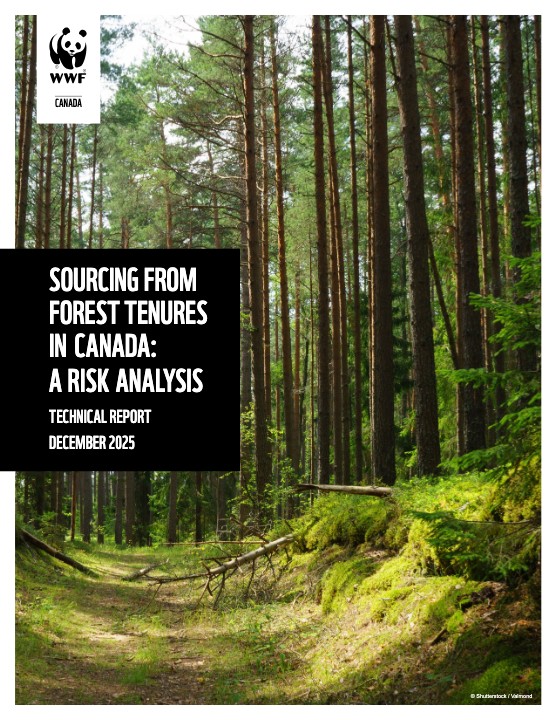
My role was production and content-specific design within an established visual system, with particular responsibility for the document’s tables and their behaviour through revision.
The entire report was built as a single InDesign text flow. The supplied manuscript came from Microsoft Word, and I retained its imported paragraph styles where useful, then applied the publication’s existing report standards to those styles. This allowed the document to remain structurally flexible while reducing unnecessary reconstruction.
Appendix I presented a specific table-design problem: a large number of narrow data columns had to remain readable across a nine-page species table. I designed an angled header system using rotated anchored text frames inside the repeating table header. The table could therefore continue automatically from page to page while reproducing the full header treatment wherever it split.
Appendix II introduced the more unusual production challenge. Its province-by-province risk tables contained hundreds of individually colour-coded values. Midway through the project, the risk palette was changed from 16 shades to a strict five-level grading system. Manually rebuilding the colour treatment would have been slow and error-prone.
Instead, I developed a small suite of AI-assisted InDesign JSX scripts to handle the conversion. One script converted tint swatches into independent process colours while replacing their uses throughout the document. Another provided controlled search-and-replace across swatch names, using a two-stage temporary renaming process to avoid conflicts during the palette migration. A final pass examined table-cell fills throughout the document and applied a character style to the two darkest risk levels so their typography reversed from black to white for adequate contrast.
Planning, writing, testing and running the scripts took under two hours and reworked the full Appendix II without manual cell-by-cell formatting. Because the report and its tables remained in a continuous flow, the resulting content could repaginate automatically, with enough flexibility to rebalance pages and avoid unnecessary half-empty pages as revisions continued.